


Dr. Dilip Raja
Urologist & Andrologist
Best Doctor For Kidney Cancer In Mumbai – Dr. Dilip Raja | Urologist, Andrologist & Uro-Oncologist
Dilip Raja, a leading and the best Doctor for Kidney and Kidney Cancer in Mumbai , brings over 35 years of experience in diagnosing and treating kidney cancer. He offers advanced kidney cancer treatment in Mumbai, including minimally invasive and robotic surgery, ensuring the best possible care for patients.
If you’re looking for expert medical care, schedule a consultation with recognized as Experienced & the Best Kidney cancer Doctor In Mumbai Today!
Get in touch with us today (+91 9820074649)
Kidney Cancer: Causes, Diagnosis, and Early Detection Advances – Explained by the Best Kidney Specialist in Mumbai Dr. Dilip Raja
Kidney cancer affects one or both kidneys and occurs more commonly in men than in women; moreover, it usually develops after the age of 45 to 50. In clinical practice, doctors treat any kidney tumors as malignant unless they prove otherwise through proper evaluation.
Expert Evaluation and Care by the Best Doctor for Kidney and Kidney Cancer in Mumbai – Dr. Dilip Raja
In addition, doctors classify these kidney tumor’s as renal cell carcinoma. Nowadays, the incidence of kidney cancer has increased; however, improved diagnostic technology has also led to earlier detection. For example, doctors now use tools such as abdominal and pelvic ultrasound (USG), CT scans, and MRI of the abdomen and pelvis to identify these tumor’s at an early stage. Dr. Dilip raja, the best doctor for Kidney cancer in Mumbai, Specialized in early detection and advanced Treatment Options, significantly improving survival rates.
How Does Kidney Cancer Affects?
Any kidney cancer or tumour, whether benign or malignant, develops due to a disruption in one or more genes within the DNA. Normally, cells multiply in a controlled manner; however, when this control breaks down, the cells begin to grow rapidly and form a mass of tissue. As a result, this abnormal growth is called a tumour or cancer.

Types Of Kidney Cancer
- Renal Cell Carcinoma (RCC) – Constitutes approximately 85% of kidney cancers.
- Transitional cell cancer (TCC) of the renal pelvis is less common and constitutes approximately 08% of diagnosed cancers.
- Benign Tumors-Benign Tumors of Kidney constitutes 5.7% of all kidney tumor for an Example : Angiomyolipoma of the kidney.
The exact causes of kidney cancer are not fully known; however, doctors identify several risk factors that increase the likelihood of developing the disease: –
- Smoking
- Certain Occupational Hazards
- Coke Oven workers & asbestos workers
- Obesity
General symptoms: high blood pressure, fever, anaemia, muscle mass loss, loss of appetite, unexplained weight loss.
- Lump or a mass felt in the kidney or abdomen region
- Dull ache on the side of the tumour
- Blood in urine (haematuria) with or without clots
- Recurrent Fevers and sometimes high Blood Pressure
- Persistent Fatigue
Investigation For Kidney Cancer
The following investigations can be done to diagnose Kidney Cancer
- Urine Analysis – Urologists commonly perform this test to detect and manage a wide range of disorders; for example, they use it to identify urinary tract infections, blood in urine, and the presence of albumin in urine. In addition, they also use it to help detect conditions such as diabetes and other kidney disorders.
- Renal Function Tests – to assess renal function is to get an estimate of the glomerular filtration rate (GFR) and to check for proteinuria (albuminuria). Most importantly it guides the uro-surgeon to assess function of both kidneys.
- Sonography of Abdomen & Pelvis with post void residual urine – makes it possible to see your abdominal and pelvic organs: kidneys, bladder, prostate, seminal vesicles, liver, gallbladder etc.
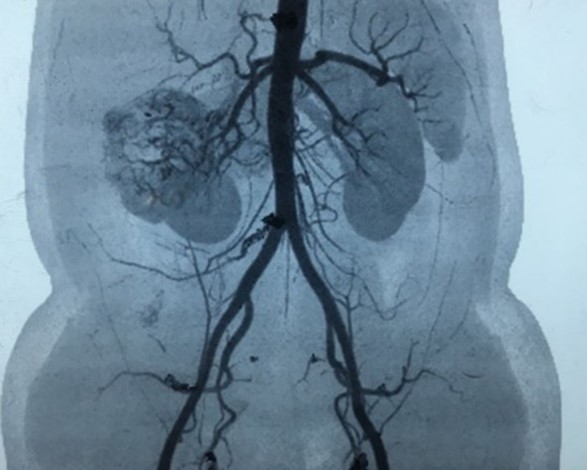
- Renal Angiography – is an imaging test to look at the arteries in your kidneys. This is important prior to surgery. This facilitates the urooncologist surgeon to dissect and trace the arteries and veins of kidney but also educates about the feeding tumour vessels. This can be done by conventional Angiography or CT Renal Angiography.
- Chest X ray and Bone Scan – Chest X Ray is a common type of exam.
- Bone scan- is a test that uses nuclear imaging to help diagnose and track several types of bone disease and the metastasis and spread of tumour to the bone.
- Intravenous Urogram with post void films – is a test that uses X-rays and a special dye to help assess function of kidneys, ureters and bladder.
- CT Urography – A computerized tomography (CT) urogram is an imaging technique used to evaluate the urinary system. It helps identify the location of a kidney tumour and assess its spread. The tumour may remain confined to the kidney or extend to surrounding tissues and other parts of the body.
It also helps in staging of kidney cancer. - MRI of Abdomen & Pelvis – to help diagnose or monitor the presence of tumour and evaluates both kidneys and other organs.
- PET Scan – is a type of test that may be used in cancer treatment to evaluate the spread of the kidney cancer outside urinary tract and within the entire body to detect metastasis and allows uro-oncologist for thorough evaluation of the extent of the cancer and its spread.
Kidney Cancer-Stages
The following investigations can be done to diagnose Kidney Cancer
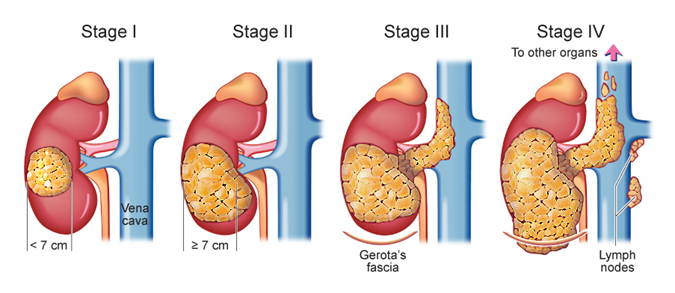
- Stage I –The tumour is 7 cm or smaller and is only located in the kidney. It has not spread to the lymph nodes or distant organs.
- Stage II – The tumour is larger than 7 cm and is only located in the kidney. It has not spread to the lymph nodes or distant organs.
- Stage III – The tumour may vary in size and extend outside the kidney, but it remains within Gerota’s fascia. It may also spread to nearby lymph nodes without involving distant nodes or other organs. In addition, it can extend into major veins like the renal vein or inferior vena cava, while sparing the adrenal gland
- Stage IV –
The tumour extends beyond Gerota’s fascia and may involve the adrenal gland. It may or may not spread to nearby lymph nodes but does not involve distant nodes or other organs.
Treatment / Surgery
- If these tests suggest that a tumour is present, it is important to know the extent, or stage, of the disease. Because kidney cancer can spread to the bones, lungs, liver, or brain, staging procedures may include special x-rays and tests to check these organs.
- Radical Nephrectomy – is the Ideal treatment for Kidney Cancer. These may require additional chemotherapy, immune therapy etc depending of extent of the disease or the recurrence of the cancer.
- Partial Nephrectomy – is the surgery for removal of entire tumour mass and preserving the healthy renal parenchyma.
- These surgeries can be achieved either by Open surgery, Laparoscopic or Robotic surgery.
Radical Nephrectomy
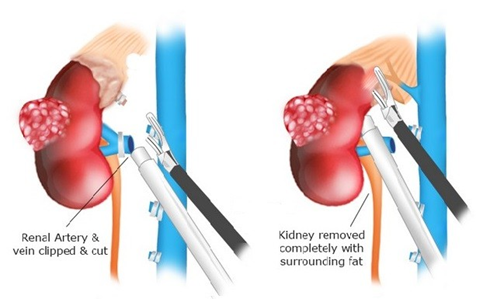
Radical nephrectomy is the standard surgery for renal cell carcinoma. During the procedure, surgeons remove the entire kidney with the tumour in situ without opening its fascia. In addition, they may remove the adrenal gland, surrounding fat, and lymph nodes, which are common sites of spread. Moreover, lymph node involvement indicates metastasis, worsens staging, and may require additional treatment and close follow-up.
Surgeons perform this surgery using open, laparoscopic, or robotic techniques.
Partial Nephrectomy
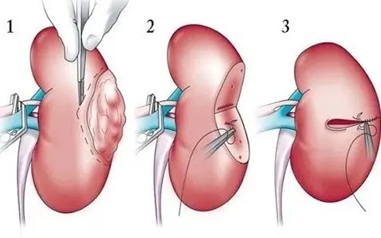
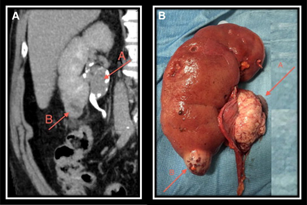
Partial Nephrectomy sometimes can be the preferred treatment for many people with a early stage of kidney cancer. Doctors perform this procedure to remove a single localized tumour measuring 4 to 7 cm. During surgery, they remove only the cancerous tumour while preserving as much healthy kidney tissue as possible. Therefore, surgeons prefer this approach in a single functioning kidney or when preserving renal parenchyma is essential. In addition, they ensure clear tumour-free margins at the periphery
Transitional Cell carcinoma of the Kidney:- It can also occur within the kidneys, and treatment follows urothelial cancer protocols. TCC of the kidney requires radical nephro-ureterectomy with bladder cuff excision and close follow-up. In addition, treatment may include chemotherapy, radiotherapy, and immunotherapy. Immunotherapy etc.
Prognostic Factors for Kidney Cancer
When diagnosing and treating kidney cancer, doctors consider several prognostic factors to predict how the disease will progress and determine the most effective treatment plan. If you’re seeking the best doctor for kidney cancer in Mumbai, understanding these factors can help guide your treatment decisions.
Key Indicator Included :
- High LDH, high Calcium levels, high white blood cells, high platelet cell count
- Less than a year from diagnosis to the need for systemic treatment.
- Poor performance status (wellbeing of the person)

Treatment Of Metastatic Renal Cell Carcinoma
- Palliative Nephrectomy – Doctors perform this surgery to control severe symptoms such as heavy bleeding, intense pain, or compression of nearby organs.
- Adjunctive Nephrectomy – means removal of the primary tumour in patient with metastasis for purpose of either prolonging survival or causing regression of metastatic lesion.
Recurrence of Renal Cell Carcinoma: Doctors define recurrent cancer as cancer that returns after the completion of treatment. It may reappear in the kidney area or develop in another part of the body.If the cancer does return, there will be another round of tests to learn about the extent of the recurrence. These tests and scans are often similar to those done at the time of the original diagnosis. Chemotherapy which cytotoxic drug may be the choice of treatment.